Why European Packaging Manufacturers Are Accelerating Investment in Double Gluing Technology
Across the global packaging industry, manufacturers are increasingly upgrading their production processes to meet changing market expectations. Among the equipment gaining stronger international demand, Double Gluing Machines are becoming an important solution for carton manufacturers seeking more stable, scalable, and cost-effective production operations.
This trend is especially noticeable in Europe, where many packaging manufacturers are continuously investing in production modernization and industrial innovation. Compared to traditional labor-intensive production methods, European factories are increasingly prioritizing equipment that can improve operational efficiency while supporting long-term cost control and production consistency.
Countries such as Germany, Italy, the United Kingdom, Poland, and the Netherlands have seen rising demand for semi-automated carton production equipment in recent years. One major reason behind this shift is the continuous growth of e-commerce logistics and retail packaging requirements throughout the European market.
Double gluing machines help support these objectives by improving bonding consistency and reducing repetitive manual operations during carton assembly. Instead of relying heavily on operator-intensive gluing processes, manufacturers can maintain more stable production output while improving carton finishing quality.
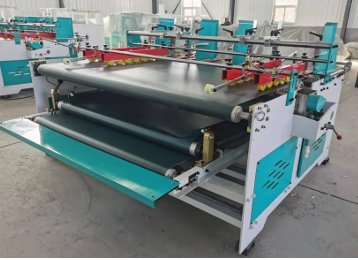
This type of equipment is widely used in industries such as Corrugated packaging manufacturing, E-commerce carton production, Food and beverage packaging, Electronics packaging, Retail and consumer goods packaging.
The Model 1800 Double Head Press-Fit Carton Gluer supports carton processing sizes from 200 × 200mm up to 1800 × 850mm, making it suitable for various packaging production requirements. Equipped with a 1.15KW motor and practical production layout, the machine is designed to support stable carton bonding performance in modern production environments.
In addition to Europe, demand for double gluing technology is also increasing across Southeast Asia and the Middle East as more factories begin modernizing their production operations. Many manufacturers are gradually transitioning from fully manual production methods toward semi-automated systems that can improve competitiveness while maintaining manageable operating costs.